|
:: Basic Comparison ::
| CHARACTERISTIC |
CAST
STEEL SHOTS |
OUR

|
| Raw Material |
Basic Raw Material has
far lower physical property & composition, obviously causes
blowholes & porosity which makes the shots to fracture into
small particle. |
Raw Material
is of exact composition without any material defect (blow holes,
porosity, shrinkage etc. ), and wears out nominally during it's
use. |
| Dust Generation |
Higher Dust generation |
No Dust generation |
| Environment Friendly |
Deteriorates environment
of work place and it's dust is considered hazardous to health |
Environment
Friendly |
| Performance Consistency |
Consistent Performance
not possible due to fast size deterioration |
Consistent
Performance |
| Time Consumption |
Higher consumption in
Shot Blasting/peening increases Working Cycle time |
Reduced Time
for Shot Blasting/Peening |
| Shot Consumption |
Higher
Consumption |
Consumption decreases i.e. 33% to 67% less to cast shots (case to case basis) |
| Inventory Cost |
Higher consumption requires
high Inventory, more money and Space as well |
Lower Inventory
required for the same job |
| Operation Cost |
Higher Operation Cost |
Lower Operation Cost |
| Shape Variations |
Shot being produced are
of mixed size hence product is a mix of various spherical sizes.
|
All shot being made out
of same wire are identical, no variation of size anywhere. |
| Hardness Variation |
They have larger variation
in hardness. |
Uniform hardness throughout |
| Micro-Structure |
In Micro-structure carbide
always there |
Micro-structure is only
Tempered martensite |
| Grain Size |
Grain size of cast
shot is unstabilized |
Due to drawing passes
grain size is stabilised |
::
Advantages ::
| CONSISTENCY |
BAPSHOT
exhibit highest consistency in size, shape, density &
hardness |
| DURABILITY |
BAPSHOT has
almost no internal defects (crack, porosity ,shrinkage
etc.), it's durability is many times as it maintains the
size longer and higher resistance. |
| NO
DUST GENERATION |
BAPSHOT do
not fracture into small particles so does not have any
dust generation. |
| LOWEST
SURFACE CONTAMINATION |
BAPSHOT leave
minimum residue on the parts surface and produces brighter
surface. |
| IMPROVE
PART FATIGUE RESISTANCE |
BAPSHOT (Conditioned)
when used for shot peening on parts, releases BAPSHOT
(Conditioned) when used for shot peening on parts, releases
|
:: Cost Savings ::
Due primarily to its superior Durability and Resistance to Fracture
as well as the absence of Iron Oxide coating, Cut Wire Shot provides
cost savings associated in Media Consumption, Dust Generated and removal
of Surface Contamination.
 |
 |
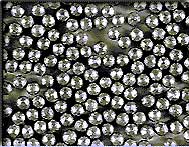
| Photo CCW35
- 1000 cycles |
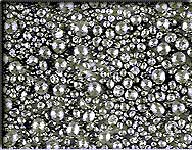
Photo CS330
- 1000 cycles |
Media Consumption - Durability testing can be done to measure representative
media life (in cycles) or breakdown rate (in grams per cycle). By
multiplying the breakdown rate (grams/cycle) by the cost of the media
($/gram), one can determine a relative cost per cycle ($/cycle)
| e.g.: |
CCW35 - Breakdown
Rate measured as 0.038 g/c, and
Cost = $0.00227/g.
Cost per cycle = 0.028 g/c x $0.00227/g=$0.000086/cycle.
CS330 - Breakdown Rate measured as 0.158 g/c, and
Cost = $0.000937/g
Cost per cycle = 0.158 g/c x $0.0009937/g=$0.000148/cycle. |
The
media consumption cost of CCW 35 is 58% that of the S-330 shot.
Dust Generation -
During Durability testing, and also during use, the Dust Generation
Rate (DGR) of a particular media can be determined. If 100 grams
of media is tested in a life Tester, a small amount of the sample
will exit the test machine as dust. The amount of dust lost divided
by the Number of cycles tested gives the DGR in grams per cycle
(g/c). Cut Wire Shot generates much less dust than other media,
and therefore cost of dust disposal can be reduced.
| e.g.: |
The cost in Cleveland,
Ohio to dispose of one 55 gallon drum
(containing 800 pounds of non-hazardous metal dust) is about
$55.00
or $0.000152/gram.
DGR of CCW35 = 0.0147 g/cycle
Cost of Dust Removal = 0.0147 g/c x $0.000152/g = $0.0000022/cycle
DGR of CS330 = 0.0254 g/cycle
Cost of Dust Removal = 0.0254 g/c x $0.000152/g = $0.0000039/cycle |
The
cost of dust removal of CCW 35 would be 56% that of the S-330 shot.
Surface Contamination -
Studies have shown that the residue left on the surface of a blasted
or peened part are much less (as much as 10 to 15 times less) with
cut wire shot compared to cast shot. On steel parts, the residue
(Iron Oxide) is not normally objectionable. But on non-ferrous parts,
it should be removed. Decontamination processes (chemical decontamination
is normally preferred) can be costly, dangerous to personnel, and
require disposal of spent chemical solutions. With surface residue
significantly reduced, decontamination time is also reduced. Exposure
of personnel to potential safety hazards is lessened and replacement
of spent chemical solutions is less frequent.
:: Detailed
Comparison ::
Improved Consistency -
Cut Wire Media exhibits the highest consistency from particle to
particle in size, shape, density, and hardness of any commonly used
metallic media.
Image Analysis was performed on various cast steel
media and equivalent conditioned cut wire (CCW) sizes. The variation
(Standard Deviation) in size of the cast shot shot was 1.5 times
that of the Cut Wire media. Image Analysis results of shape (roundness)
evaluation showed CCW media 2 times more consistent in shape than
equivalent cast shot sizes. Comparing hardness specifications -
cast shot normally meets an 11 point Rockwell C Hardness range (e.g.:
HRC 55-65, HRC 40-50, HRC 42-52) whereas CCW media ranges are normally
6 points or less (e.g.: HRC 55-60, HRC 50-55, HRC 56-59). The density
of Cut Wire Shot is the same as that of normal high carbon steel
- 7.8 grams/milliliter. Due to the large number of Internal Defects
may be present, specifications allow the density of cast shot to
be as low as 7.0 grams/milliliter - over 10% lower than Cut Wire
Media.
Highest Durability -
Because of its wrought internal structure with almost no internal
defects (cracks, porosity, shrinkage, etc.), the Durability (Life)
of CCW media can be many times that of cast shot of equivalent size
and hardness. Life testing in Laboratory and Production equipment
have measured the Life of CCW shot to be as much as 10 times that
of equivalent size and Hardness cast media.
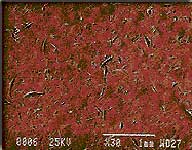
In addition to the Durability of media, the mode of breakdown is
very important, especially in shot peening applications. Most media
deteriorates by forming broken (fractured) particles. CCW media's
mode of deterioration is wear. CCW particles tend to wear down into
smaller diameter pieces rather than fracture into sharp edge broken
particles.
 |
 |
| Surface Damage |
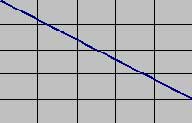
Fatigue Life
vs. % Broken Shot |
Dust Generation -
Since CCW media exhibits the highest Durability and Resistance to
Fracture, it also exhibits the lowest dust generation rate of the
commonly used media.
Lowest Surface Contamination -
All media leave a residue on the surface of the part being blasted
or shot peened. Those media that fracture rapidly can leave tiny broken
particles imbedded in the part surface. Other media leave a very thin
smear on the part surface. CCW media does not breakdown as quickly
as other media and does not tend to fracture into the tiny particles
that may imbed themselves into the part surface. Finally CCW media
does not have an Iron Oxide coating over the entire particle surface
which rubs off on the part being processed. Therefore CCW media leaves
much less (as much as 10 to 20 times less) residue on the part surface.
Improved Part Fatigue Resistance -
Fatigue tests have been performed on actual parts as well as laboratory
specimens to determine if one steel media is equal to, or better than,
another in terms of part life. Parts and specimens shot peened. with
CCW shot exhibit higher average life and more consistent life than
those peened. with equivalent cast steel shot.
|